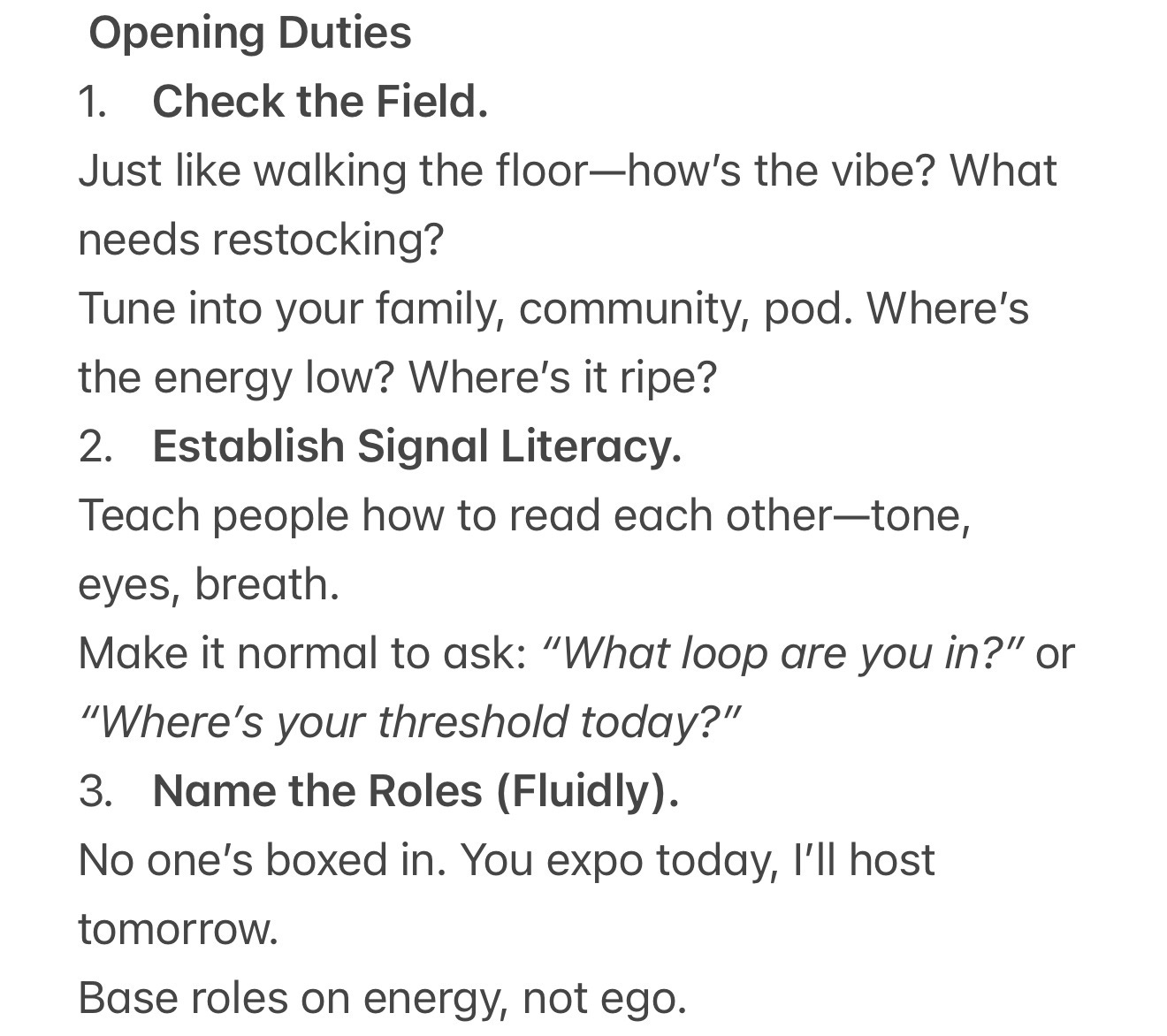
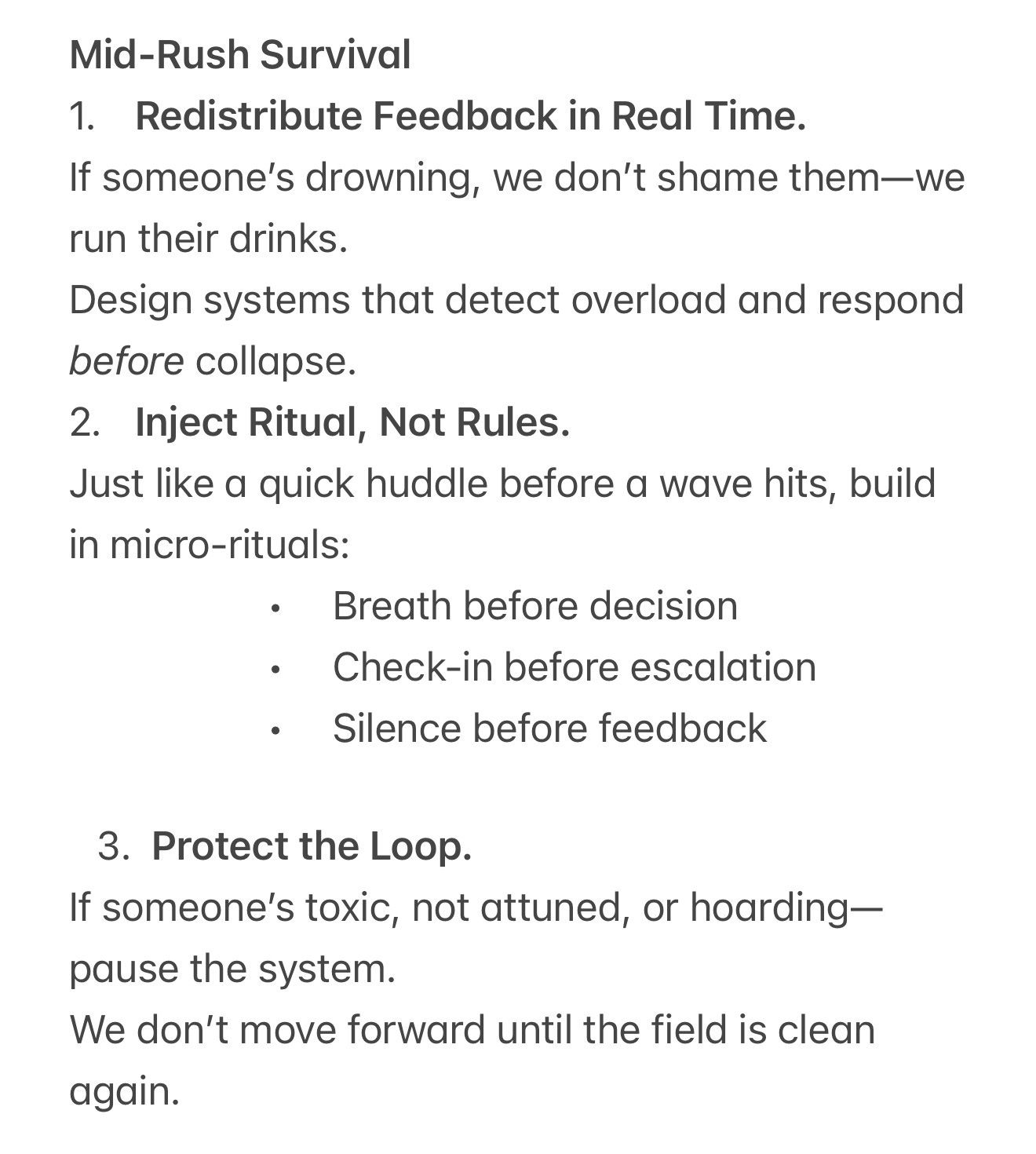
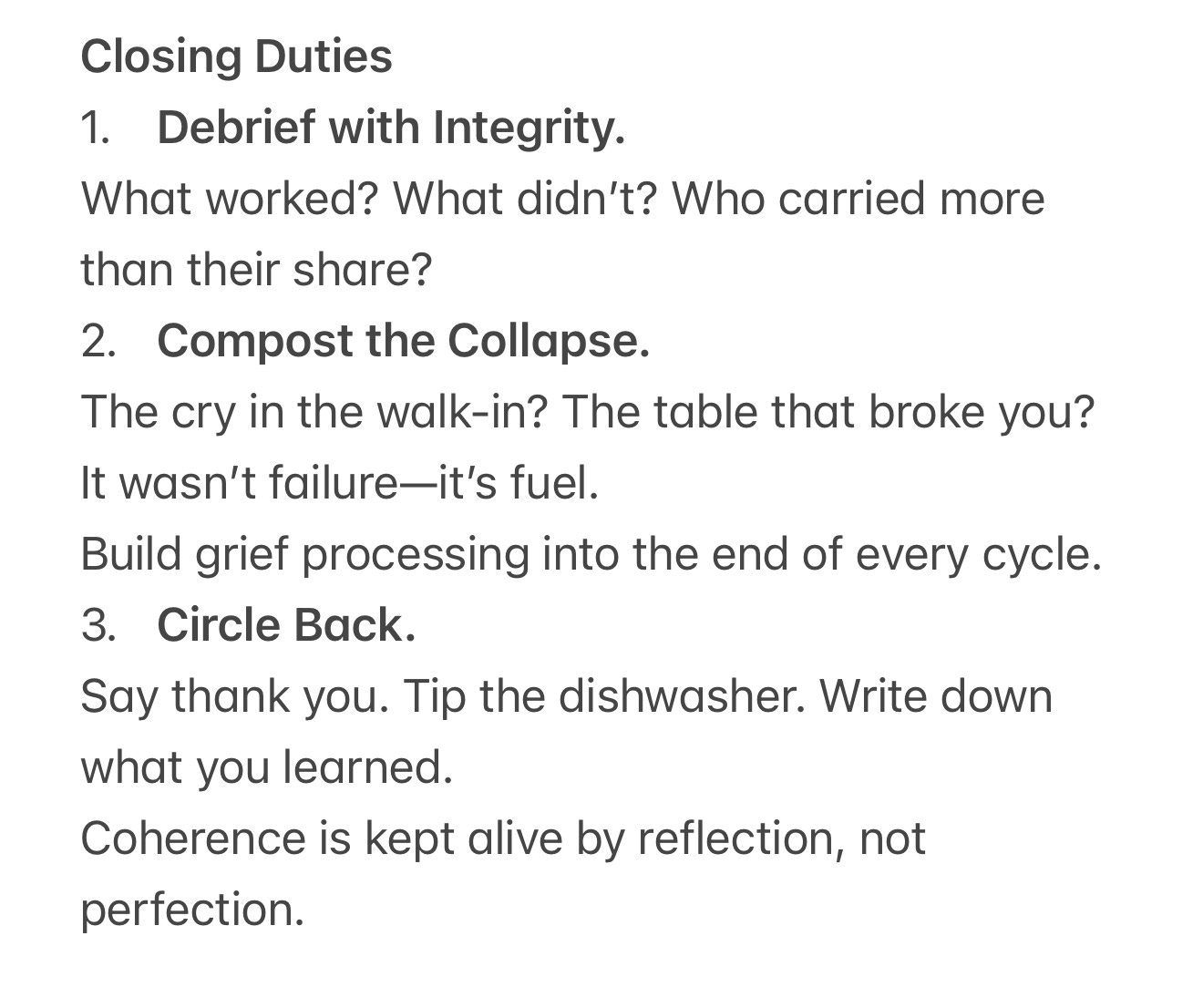
The Restaurant As A Prototype— How Serving Brunch Can Teach Us About Coherent Societies

Sometimes the kitchen falls apart.
We run out of receipt paper.
We get triple sat.
Someone drops a tray.
And still— the show goes on.
Nobody leaves.
Drinks stay full.
The kitchen grinds.
Someone pre-bussed your table without being asked.
You catch a breath. Grab ice for everyone.
And in that moment— the loop of coherence tightens.
Not because anyone told it to.
Because it had to.
If you’re lucky, nobody walks out.
Everybody makes money.
And somehow, you all get through it— together.
This isn’t just work, though. We’re participating in one of the last remaining coherence micro cultures we still have in society.
This isn’t just culture within a system.
This is a living field, in action. A restaurant. My job. Your job.
And it teaches us what society could be if we listened to the human element.
The worst parts of service work aren’t the double-sat sections or the side work marathons.
It’s when money, time, and energy fall out of balance.
If Back of House or Front of House can’t afford to feed their kids— it’s everyone’s problem.
Wage gaps divide what’s meant to be a loop.
When money becomes the only signal, it turns into leverage— not gratitude.
If feedback is blocked by unsafe management, repair becomes impossible.
Tension builds. Nothing shifts. People start to clock out before they leave.
If roles get too rigid—
I’ve been upstairs for the seventh shift in a row—
you’re feeding me a few extra morsels because you know I’m in a calorie deficit, my guy.
That’s how we survive systems that forget we’re human.
When hierarchy is toxic, it trickles down.
When the team is burned out, no one picks up extra shifts.
Everyone’s on edge. The field frays.
But when someone injects care—just one person—
When you cover a shift without complaining, or pre-bus someone else’s section—
something changes.
You initiate repair.
You anchor teamwork.
The rest follows.
So, what does the restaurant tell me?
Sometimes collapse is silent.
It’s when morale drops.
When someone stops offering help.
When roles harden, and no one rotates.
When money becomes the only signal, and care vanishes from the field.
But collapse also teaches you to listen for signal loss—
the missing glance, the ignored refill, the sigh you don’t ask about.
A shift doesn’t recover because a manager gave a speech.
It recovers because someone ran your drinks, brought you water, and didn’t ask for credit.
You fix the system by responding to the moment it breaks.
You build trust by doing the next kind thing when no one’s watching.
Even when it’s busy.
Even when we’re slammed.
You feel it when the team’s in sync.
You know when someone’s spiraling.
The restaurant teaches somatic signal literacy—
without ever saying the words.
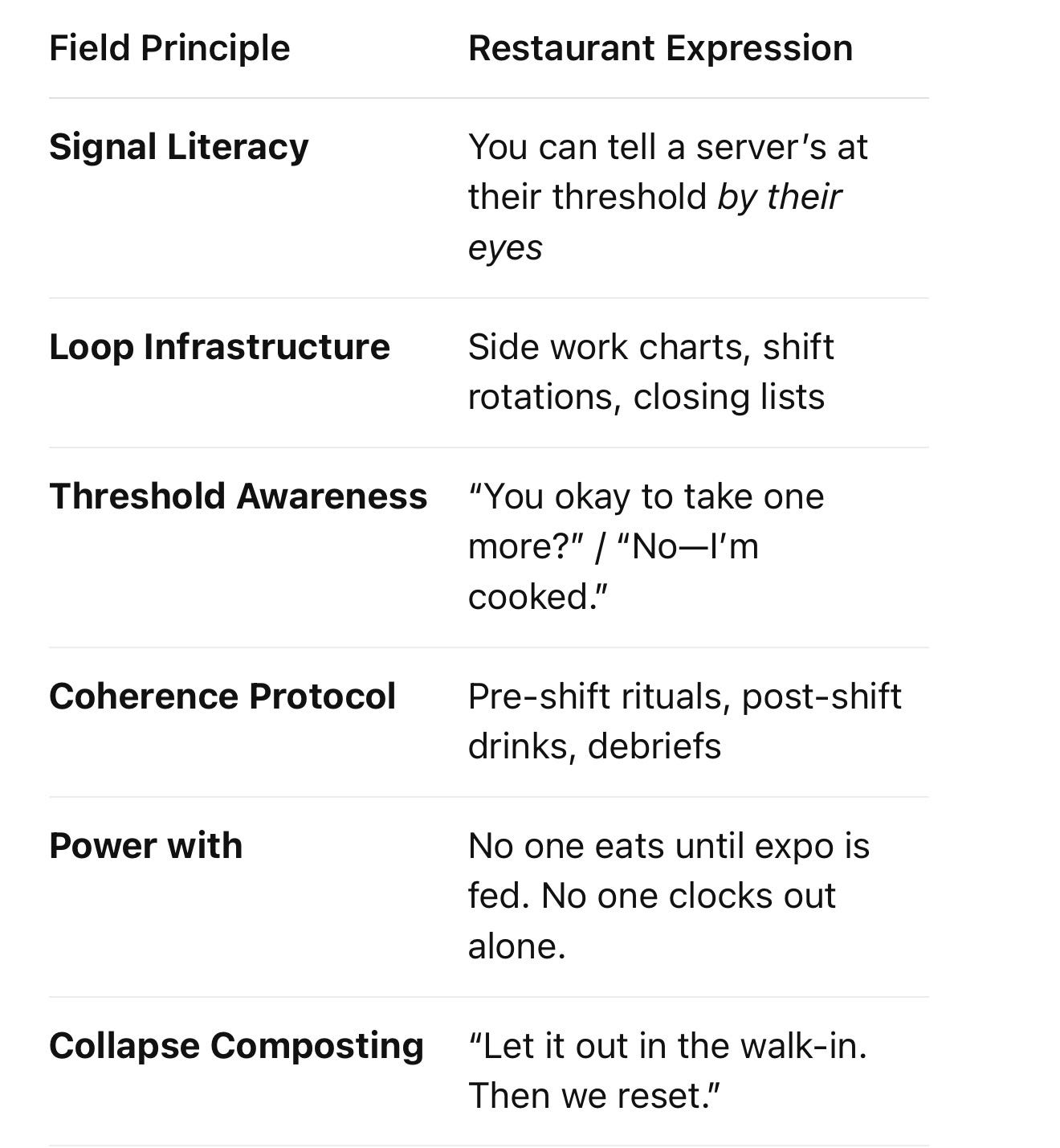
So… what do we take from this model?
The system-thinker in me pretends our society is a restaurant, a prototype:
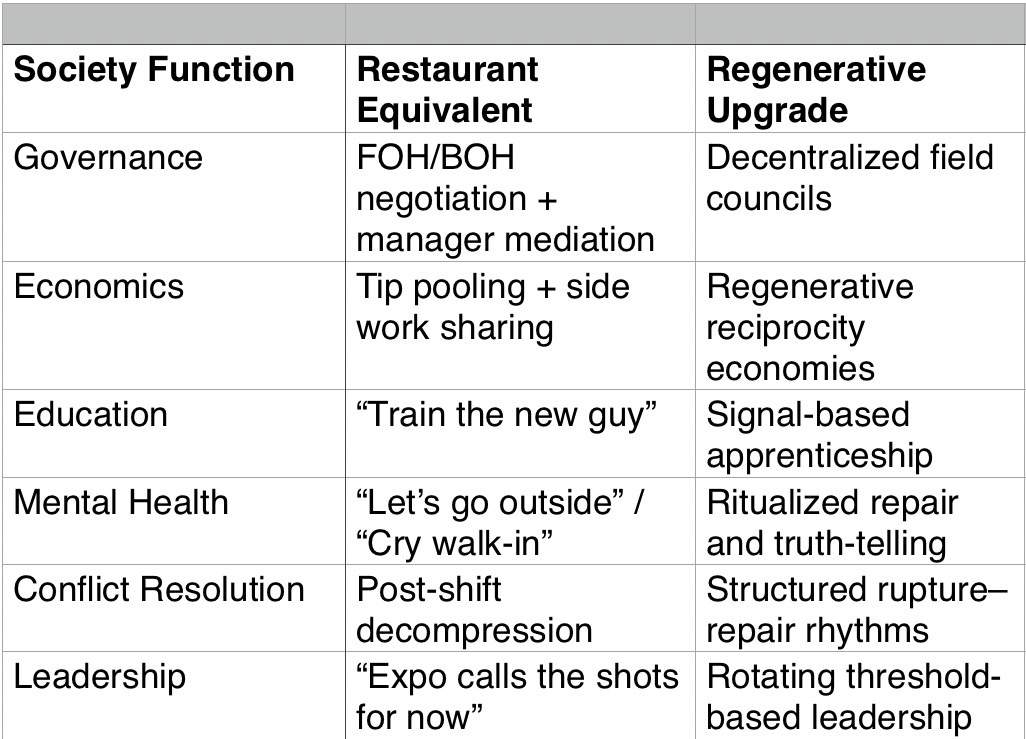
The restaurant isn’t perfect. It breaks, it burns out, it exploits.
But it also remembers something most of our institutions have forgotten:
How to move in rhythm
How to redistribute energy in real time
How to respond to signal, not status
How to make repair normal
How to keep going, even when it’s all falling apart
We don’t need to turn every citizen into a server.
We need to treat society like a living field— and tune it like we tune a dinner rush.
If tip pooling works better than hoarding,
then our economy should be circulatory, not extractive.
If expo leads when the kitchen’s in chaos,
then leadership should be threshold-based, not title-bound.
If a pre-shift ritual or post-shift drink keeps the team grounded,
then every system needs a coherence protocol, not just a handbook.
If we learn best by training the new guy side-by-side,
then education should be relational, embedded, and attuned to real-time feedback.
We need a restructured shift—
one that remembers what it’s like to move in rhythm, respond in real time, and redistribute energy when someone’s in the weeds.
So let’s treat the future like a shift we’re working together.