The Compass and The Clock

On knowing where you’re going before the world is ready for you to go there
By Ariel Willingham
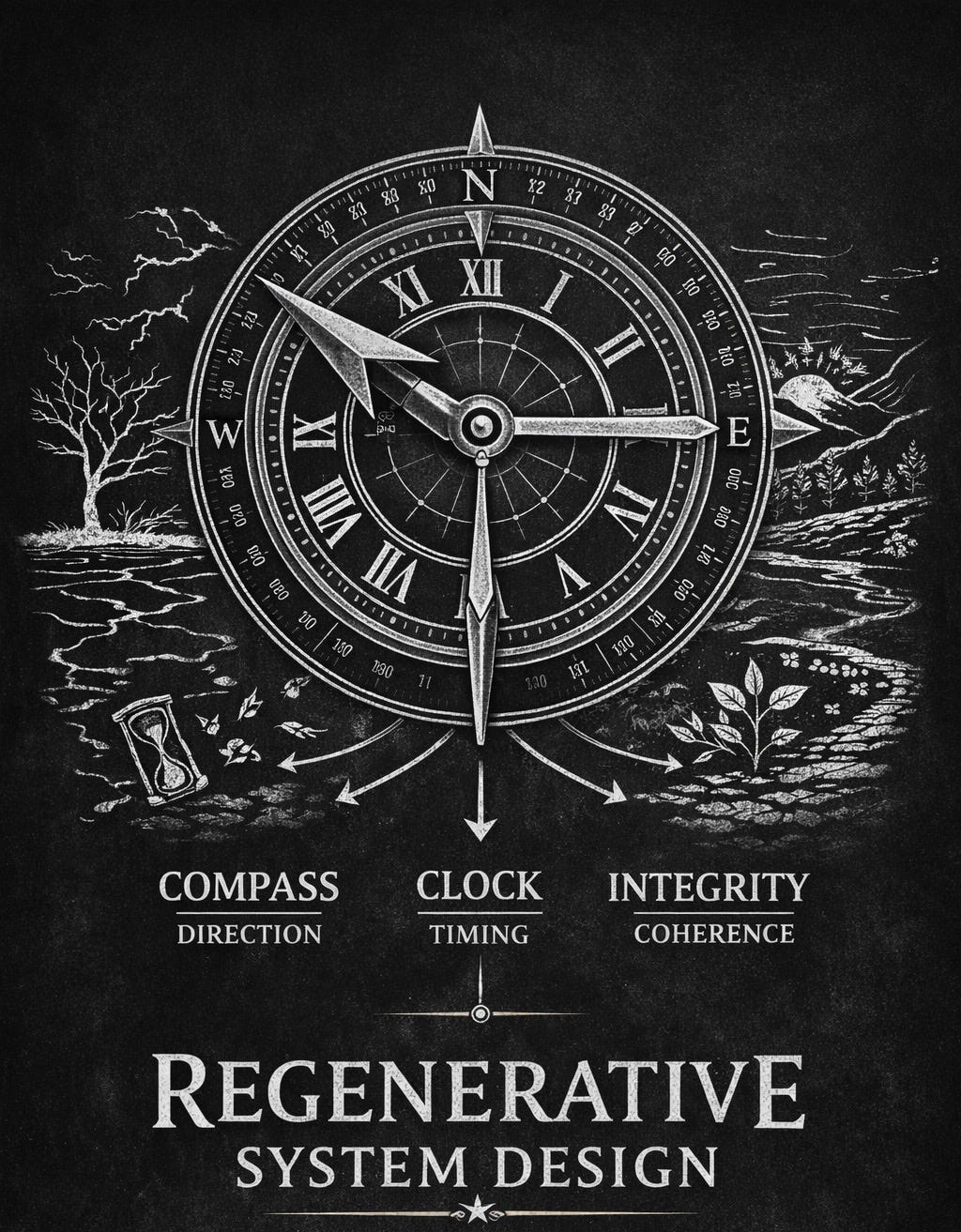
Tick-Tock
Humans have always built tools to see more clearly.
The compass didn’t tell us where to go. It told us where we were in relation to everything else— so that the direction we chose was a real direction, not a guess. The clock didn’t tell us what to do with our time. It told us where we stood inside it— so that our actions could be sequenced, coordinated, and placed.
These are orientation tools. Not productivity tools, not optimization tools. They are tools that locate us inside a larger system so that our movement through it is legible to you, the walker.
We have been building and refining instruments like these for as long as we have been trying to navigate anything. The compass, the clock, the map, the calendar, the chart. Each one a way of seeing structure that the naked eye cannot hold alone.
This isn’t new. What has changed is what has happened to them over time—how they’ve been shaped, strained, and distorted as coherence with integrity has weakened and drift accumulated.
What Extraction Takes
In Midland, Texas, the clock belongs to oil.
Not metaphorically— structurally.
The boom and bust cycle of a single-industry extraction economy sets every other rhythm in the community. When to hire, when to cut. When to build, when to abandon. When to stay, when to leave. The dominant industry doesn’t just extract resources from the ground. It extracts orientation from the people living around it. It replaces the community’s compass with its own clock.
This is what extraction does wherever it operates— and it operates far beyond oil towns.
It operates in institutions where the metrics of the dominant system replace the judgment of the people closest to the work. It operates in organizations where quarterly targets override the slower rhythms of trust-building and relational depth. It operates in communities where outside capital sets the development agenda and local knowledge is treated as noise. It operates in any system where the people doing the work have been separated from the instruments that would tell them where they actually are.
Extraction is not only an economic category. It is an orientation event. It takes the compass and replaces it with someone else’s clock. And then it measures you by how well you perform against a timeline you did not set, toward a destination you did not choose, in a system whose coherence serves someone else’s interests.
The result is a particular kind of disorientation— one that is easy to misread as personal failure. You keep building. You push. You bring genuine vision and real commitment to the work. And things don’t hold. Not because the direction was wrong, but because the ground was never mapped, the sequence was never read, and nobody handed you a way to tell the difference between a compass problem and a clock problem.
Not only have most of us been taught to ignore our own compass and clock, we’ve also stopped teaching each other how to read them at all. Over time, even the shared literacy for orientation and timing has eroded. You can see it reflected in something as simple— and as structural— as declining literacy rates across the country: a signal that our ability to read the world, and each other, is weakening at the same time our systems demand more precision than ever.
The Moment Orientation Returns
We’ve seen this pattern before, in different forms. A tale as old as time: when something doesn’t work, it’s rarely because the idea is wrong— it’s because we’re not aligned in both where we are and when we are. We move with clarity in one dimension while missing the other, and the mismatch quietly undoes the effort.
The compass: where does this belong, what depends on what, what is the structural logic of this system I’m trying to build or repair?
The clock: what time is it actually, what conditions exist right now, what has to be present before the next thing can root?
These are not the same question. They have almost never been held in the same frame. And the gap between them— the distance between where the compass points and what the clock confirms— is where most systems work actually lives. Not in the vision, not in the execution, but in that gap.
Seeing it doesn’t solve it. But it ends a particular kind of suffering— the suffering of compass-clear people in clock-resistant environments who have been treating a sequencing problem as a personal failure.
Once we can name it, we can stop collapsing it inward.
And once we can see the difference between orientation and timing, a different question becomes possible.
Not: what should we build?
But: what can actually be built here, now, in this order, without the system breaking?
If a Compass And a Clock Had A Baby… Plus Integrity
I’ve been building something to hold that question in a structured form—not as advice, and not as theory, but as an instrument.
In parallel, I’ve been refining a body of systems thinking and social theory with mentors, tightening it toward something operational: something that can actually sense conditions, not just describe them.
The aim is to translate that into software that helps people see what is actually buildable in a given context—and what is not.
Not based on preference. Not based on vision.
But based on conditions.
A Pre-Execution Reality Filter for regenerative system design.
Most planning tools help you decide what to build. This one helps you determine what not to build yet—and why. It operates on a fundamentally different function: elimination before construction.
It uses a Via Negativa logic— removing non-viable paths so viable ones become visible without projection or ideology.
How It Works
It is a deterministic inference engine that triangulates five layers of context:
• economic structure
• existing infrastructure
• pressure language (what is being demanded vs. what is being avoided)
• system tier (local, institutional, meta-systemic, etc.)
• scale compatibility
It does not treat these as isolated inputs. It reads them relationally— inferring what is not explicitly said and surfacing structural constraints that individual perspectives cannot see.
What It Produces
What comes out the other side is not a plan. It is a set of constraints made visible.
Sometimes it says: not yet.
Sometimes it says: yes, but only under these conditions.
Sometimes it says: this idea is real, but it is being asked in the wrong layer of the system.
It translates complexity into a kind of clarity that is not motivational— but stabilizing.
Not “you can do this.”
But “this is what is actually here.”
What It’s Actually Doing
Most systems help people move faster toward what they already want.
This one interrupts that motion long enough to ask whether the wanting itself is structurally coherent.
It introduces a pause—but not a delay.
A calibration point.
A moment where intention is forced to meet conditions.
And in that meeting, something important happens:
Some ideas dissolve immediately.
Not because they are bad—but because they were never supported by reality in the first place.
Others don’t disappear—they simplify.
They lose their excess. They become buildable.
And a smaller set emerges that feel strangely clean. Almost obvious. As if they were already there, waiting for conditions to catch up.
What Makes This Different From The Other Work
This tool is not trying to inspire action.
It is trying to prevent misaligned action from becoming permanent structure.
Most planning tools assume building is neutral— that effort equals progress. This one assumes something more careful:
That building is always an imprint on a system.
And imprints can either clarify a field—or distort it for years.
So instead of asking:
“Can we do this?”
It quietly asks:
“If we do this, what does it do to everything around it?”
Last Call—
This tool will be published on GitHub as soon as I finish my little 12-9 shift.
In the in-between space— standing behind a register, cashing people out, watching the flow of ordinary transactions— I keep returning to the same quiet recognition: something else is already forming in parallel. A second layer of attention taking shape through the same hands that move through the current system. Faith and kindness, always with me.
What keeps me going is not certainty. It’s the sense that construction is already happening elsewhere—slowly, unevenly, but persistently— regardless of what burns in the process of getting there.
The question is no longer abstract.
It is immediate, almost physical:
What will we build?
And just as importantly:
What will we refuse to build, because we’ve finally learned to see the cost before the structure exists?
Author’s Note—
This tool is an attempt to make something that does not yet have a stable category.
It sits between systems theory, software design, and lived experience— formed from the friction of trying to think clearly inside conditions that often reward speed over coherence.
It is not meant to optimize ambition. It is meant to slow distortion at the point of entry.
If it feels like it interrupts momentum, that is intentional. Most harm in systems work does not come from what is built, but from what is built without sufficient regard for the conditions it enters.
This instrument is an attempt to make that threshold visible.
It is also personal.
This work has been built in the margins of everyday labor—in the pauses between transactions, in the after-hours thinking, in the ongoing effort to reconcile survival with the desire to contribute to something more structurally honest. That tension is not separate from the tool. It is part of it.
Nothing here is offered as final truth. It is a prototype of perception.
If it proves useful, it will be because it helps people see something they already sensed but could not yet formalize:
that not everything ready to be imagined is ready to be built.
This will be released on GitHub after my shift ends today.
Thank you guys for your unending support on this journey of systemic analysis, solution creation, imagineering, stewardship/mentorship…. There is no better way to spend my time than in THIS thought space. Thank you for that gift.
— A
Having followed your posts for a while I now know that your name in my inbox means I can expect a wonderful, resonant blend of homecoming and revelation. This post is no exception. Looking forward to experiencing the new tool.