Post-Hegemonic Design

The Tools for a Humane Future
By Ariel Willingham
May Our Grim Past Guide Towards Brighter Futures
We did not lose global leadership because another country out-competed us. We lost it because we changed what leadership meant.
For most of the post-war era, American power was built on stewardship.
We created systems others could rely on: trade frameworks, financial stability, security alliances, and legal norms. We absorbed costs so the whole system stayed predictable.
That reliability— not raw force— is what made the United States hegemonic.
But over the last few decades, a different philosophy quietly took over. Institutions stopped being something to maintain. They became something to leverage. Alliances became transactions. Trade became a weapon. Truth became a bargaining chip. Even democracy became negotiable.
This cultural shift was captured in one phrase: The Art of the Deal.
Deals reward short-term wins. Civilizations require long-term trust. You can bluff in a negotiation. You cannot bluff in a shared reality.
When tariffs replace treaties, when contracts replace commitments, and when humiliation becomes a strategy, the world stops feeling safe inside your system. It doesn’t revolt. It builds exits.
Supply chains reroute. Currencies diversify. Alliances loosen. Technology standards fragment. It is the predictable response to a system that stopped behaving like a steward and started behaving like a trader.
We are now watching the result: a multipolar world emerging not because the U.S. was defeated, but because it made itself unreliable.
The danger of this moment is not the end of American dominance.
It is what happens when dominance dissolves without new ways to coordinate, trust, and share reality.
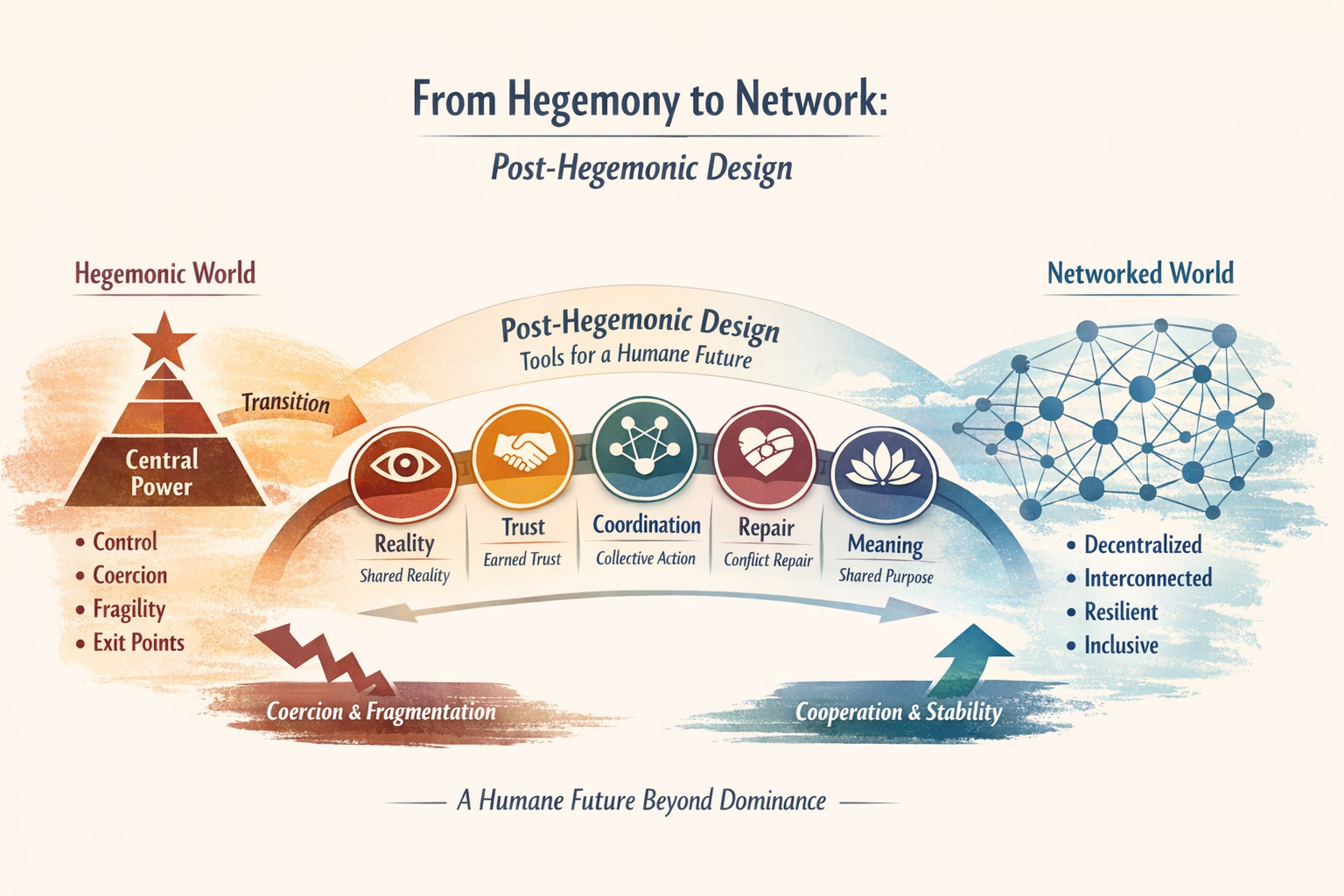
That is where Post-Hegemonic Design begins.
The world that is replacing American hegemony is not a set of isolated powers. It is a single, deeply interwoven system: Energy grids cross borders. Supply chains span continents. Financial flows move in milliseconds. Information travels instantly. Even climate and disease ignore national lines.
We are no longer a collection of separate nations— we are a shared network. And when that network loses a central steward, power does not disappear; it disperses. The danger is not fragmentation; it is ungoverned connection.
In a networked world without shared reality, trust, or repair, actors begin taking without permission— data, labor, resources, dignity— because extraction becomes frictionless. That is how multipolarity turns brutal. Post-Hegemonic Design exists to make sure it doesn’t.
What Comes After Hegemony
The end of unipolar dominance does not create a vacuum. It creates a networked world.
Power no longer sits in one capital.
It flows through:
• cities and regions
• trade corridors and energy grids
• technology standards
• climate and security compacts
In this world, reliability becomes power.
The actors who coordinate well, keep their word, and stabilize others become the new anchors of the global system.
Those who weaponize trade, break agreements, or treat truth as negotiable lose influence— even if they still look strong.
This is not chaos. It is a different architecture of order. But without new tools, it is also dangerous.
When power spreads out without shared reality, trust, or repair, systems don’t become free. They become violent.
So we have to build what empires used to provide— without using empire.
That is what Post-Hegemonic Design is.
What Post-Hegemonic Design Is Pointing At
Post-Hegemonic Design is the practice of building the social, technical, and cultural interfaces that let power decentralize without people tearing each other apart. Allow me to further explain.
When empires ran the world, they provided five things by force:
• shared reality
• trust
• coordination
• conflict resolution
• and meaning
When empires fade, those don’t disappear— they become ungoverned. So we design them instead.
Every humane civilization, no matter how distributed, needs five interfaces.
1. Reality Interfaces
What is actually happening?
Brutality begins when people can no longer agree on what is real. I design tools that map:
• systemic loops
• institutional failures
• power flows
• and emerging risks
So communities, journalists, workers, and cities can see the same field instead of fighting over propaganda. Shared reality is the first defense against panic, extremism, and war.
2. Trust Interfaces
Who can I rely on?
In a decentralized world, cooperation depends on behavior.
I design systems that track:
- reliability
- repair
- contribution
- and integrity
So people and organizations can work together based on what others actually do— not what they claim. This replaces blind markets and coercive control with earned trust.
3. Coordination Interfaces
How do we act together without a boss?
As central authority weakens, people still need to:
- fund projects
- make decisions
- govern
- and resolve conflict
I design pod-based, federated, and cooperative frameworks that let groups self-organize without a single controlling center. This prevents power vacuums from turning into chaos.
4. Repair Interfaces
What happens when harm occurs?
Every system generates conflict. The difference between humane and brutal is what happens next.
I design tools that:
- surface grievances
- track loops of harm
- and guide repair instead of denial, punishment, or exile
This keeps societies from radicalizing and tearing themselves apart.
5. Meaning Interfaces
Who am I now?
When empires fade, identity fractures.
I design narratives, cultural tools, and dignity-preserving frames— what I call The Art of Humanity — so people do not have to become cruel to feel important. This is how you prevent humiliation politics and authoritarian nostalgia.
What’s Being Built
As power spreads out across cities, regions, networks, and alliances, the world does not become simpler— it becomes more interconnected. Decisions made in one place ripple everywhere. Supply chains, energy grids, information systems, and cultural narratives link billions of people into a single living web.
In that kind of world, stability no longer comes from domination. It comes from coherence.
A humane future depends on whether people can still:
- see what is actually happening
- trust one another enough to cooperate
- coordinate across difference
- repair harm before it metastasizes
- and belong without being forced to submit
Those capacities do not emerge automatically when empires fade. They have to be designed.
That is what we are building:
the interfaces that allow a distributed civilization to stay intelligible, relational, and sane as the old center gives way.
Not a single authority. Not a new empire. A living system of shared awareness, trust, coordination, repair, and meaning. That is how a post-hegemonic world stays human.
The Choice in Front of Us
There are two ways this transition can go.
One path runs through fear:
It tells people they are being replaced, humiliated, or robbed of their identity. It turns trade into coercion, difference into threat, and uncertainty into rage. It concentrates power in strongmen, strips dignity from the vulnerable, and uses spectacle to mask extraction.
That path leads to fragmentation, repression, and violence— even if it calls itself strength.
The other path runs through design:
It accepts that power is dispersing, and chooses to build the systems that let people cooperate without coercion. It invests in shared reality instead of propaganda, in trust instead of intimidation, in repair instead of revenge, and in dignity instead of domination.
That path leads to decentralization that is livable, to diversity that is stable, and to a world that can change without tearing itself apart.
Post-Hegemonic Design exists for this reason. Not to decide who wins, but to make sure the transition does not become cruel.
That is the work. And it has already begun.
Why Attunement Is the Missing Architecture
Empires never needed to be attuned. They could command. They could coerce. They could punish. When something broke, they applied force until it stopped moving.
That worked as long as power was centralized and slow. When one capital controlled currency, trade routes, and military force, it didn’t need to feel what was happening across the system. It only needed to enforce compliance.
A networked world does not work that way.
Today, power is distributed across cities, platforms, supply chains, financial systems, energy grids, and communities. No single authority can see the whole picture, let alone command it. Decisions ripple across the globe in real time. A shipping disruption in one region affects food prices in another. A policy change in one country reshapes migration patterns in ten more.
In a system like this, stability does not come from obedience. It comes from responsiveness.
That is what attunement is.
Attunement is the capacity of a living system to sense what is happening inside itself— where pressure is building, where trust is breaking, where harm is occurring, and where connection is fraying — and to respond before those stresses turn into rupture and collapse.
Healthy nervous systems do this constantly. A body feels pain before tissue is destroyed. A mind registers fear before danger becomes overwhelming. A family notices tension before it turns into estrangement.
Civilizations have never been built this way.
Industrial society was designed for output, not listening. It optimized for efficiency, not coherence. It measured growth, not strain. It tracked profit, not pain. Its feedback loops were financial and bureaucratic, not human and relational.
So when systems began to fail, they didn’t adapt.
They doubled down.
More extraction. More control. More enforcement.
That is why so much of modern power feels brittle, disconnected, and cruel. It is trying to run a living world with the logic of a machine.
Post-Hegemonic Design is an attempt to give civilization something it has never had before: a nervous system.
How Attunement Integrates into the Model
The five interfaces of Post-Hegemonic Design are not separate tools. They are the sensory organs of a collective nervous system.
Each one performs a vital function:
Reality interfaces provide perception— what is actually happening across the field.
Trust interfaces provide memory— who has been reliable, who has repaired, and who has caused harm.
Coordination interfaces provide movement— how groups act together without coercion.
Repair interfaces provide healing— how conflict and damage are metabolized instead of suppressed.
Meaning interfaces provide identity— why people belong, care, and stay engaged.
Attunement is what keeps these layers in relationship with one another. It is the feedback loop that lets perception inform trust, trust guide coordination, coordination trigger repair, and repair restore meaning.
Without attunement, each layer becomes distorted. Reality turns into propaganda. Trust becomes branding. Coordination becomes control. Repair becomes punishment. Meaning collapses into ideology. The system still functions— but it becomes rigid, brittle, and dangerous.
With attunement, the same layers become living.
Stress is noticed early. Conflicts are addressed before they metastasize. People feel seen instead of managed. Cooperation remains voluntary instead of forced. Identity remains flexible instead of defensive.
This is the difference between a machine and an organism:
Empires were machines. Networks must be organisms.
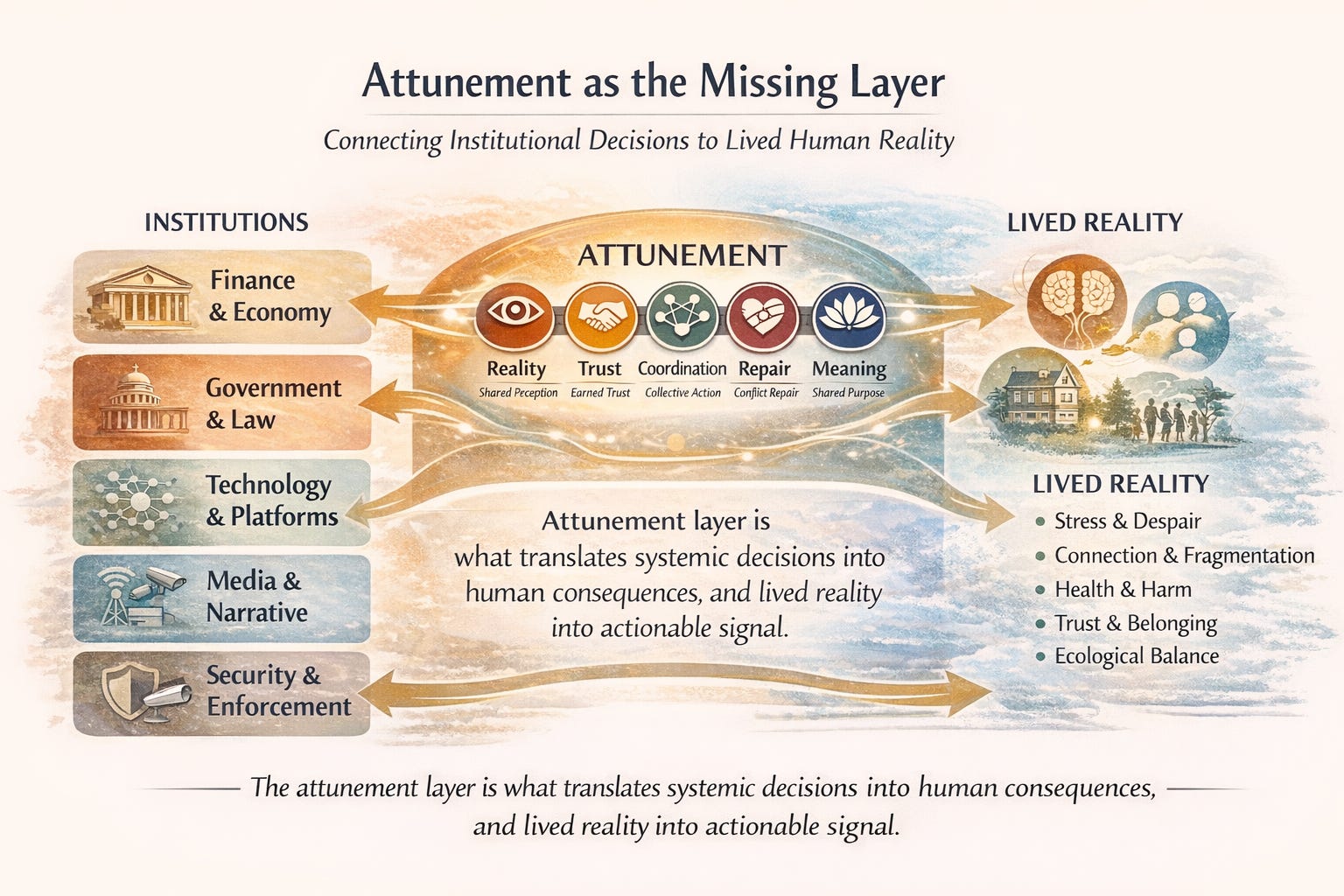
What is missing from modern civilization is not intelligence, data, or power. It is an attunement layer between institutional decision-making and lived human reality. Policies are made, markets move, and systems optimize— but the actual experience of people and communities only becomes visible after damage is done.
Attunement is the missing translation membrane: the layer that turns what life feels like on the ground into actionable signal for those shaping the system.
The Five Institutional Power Blocks
When people talk about “the system,” they often mean something abstract. But in practice, most of what shapes human life flows through five concrete blocks of institutional power. These systems decide how resources move, how truth is shaped, how safety is enforced, and who gets to belong— often without ever feeling the human consequences of their decisions.
In a post-hegemonic, networked world, these institutions still exist. What has changed is that they no longer operate under a single coordinating authority. They act independently, guided by metrics, incentives, and internal logics that rarely include the lived experience of the people they affect. That is why attunement is no longer optional. It is what prevents these systems from drifting into cruelty without meaning to.
Finance and the economy sit at the center of this dynamic. Banks, markets, corporations, and trade systems quietly decide who receives investment and who is pushed into debt, which regions flourish and which are hollowed out. Their language is numbers — stock prices, interest rates, quarterly earnings — but those numbers translate directly into layoffs, foreclosures, broken communities, and chronic insecurity. Without attunement, the economy becomes a machine that extracts value until something breaks. With attunement, it becomes a living system that can sense when it is harming the very people it depends on.
Government and law form the next layer. Legislatures, courts, agencies, police, and immigration systems decide who is protected, who is punished, who belongs, and who is made to disappear. These institutions operate through rules, case counts, and enforcement targets. They can technically follow the law while still tearing families apart, destabilizing communities, and destroying trust. Without attunement, law becomes cruelty disguised as order. With attunement, it becomes a framework for accountability that actually serves human dignity.
Technology and platforms now sit alongside government as a form of governance. Social networks, AI systems, data brokers, and cloud infrastructure determine who is seen and heard, what spreads, and what is buried. They shape attention, emotion, and belief at planetary scale, yet they do not feel what their systems do to nervous systems, relationships, or democratic culture. Without attunement, technology accelerates chaos and exploitation. With attunement, it becomes a tool for connection, sense-making, and collective intelligence.
Media and narrative shape the emotional atmosphere of society. News, entertainment, political messaging, and cultural storytelling decide what feels real, what feels dangerous, and what feels possible. They do not just describe the world — they create the field people live inside. Fear, rage, humiliation, and hope are produced here. Without attunement, media becomes a weapon that fractures reality. With attunement, it becomes a shared mirror that helps society see itself clearly.
Finally, security and enforcement hold the sharpest edge of power. Militaries, police, surveillance systems, border regimes, and prisons decide who is safe, who is targeted, who is contained, and who is removed. These institutions deal in force, yet they are often insulated from the human cost of what they do. Without attunement, security becomes repression. With attunement, it becomes protection.
In the hegemonic era, a central authority forced these systems into alignment through hierarchy and coercion. In a networked world, that center no longer exists. If these five power blocks act without attunement to lived human reality, they will drift, collide, and escalate harm— even when each believes it is acting rationally.
Post-Hegemonic Design does not seek to abolish these institutions. It seeks to give them something they have never had before: the ability to feel what they are doing, and to change before the damage becomes irreversible.
So… Let’s Talk Tools
Post-Hegemonic Design is not an abstract philosophy. It is a practical way of building attunement into systems that have never been able to feel what they are doing.
These tools exist for one purpose: to create feedback loops between institutional power and lived human reality, so harm, strain, and instability become visible early enough to be addressed— before they harden into collapse.
Some of these tools are about seeing.
Field Scans and reality-mapping frameworks are used to show what is actually happening inside a system, beyond what official metrics or press releases reveal. They surface stress points, distortion loops, and suppressed feedback so communities, journalists, and decision-makers can look at the same landscape instead of fighting over incompatible stories.
Some of the tools are about trust. I build ways to track reliability, repair, and contribution over time— not through branding or status, but through observable behavior. In a networked world, cooperation cannot depend on authority alone. It depends on knowing who actually keeps their word. These trust and signal maps make that legible.
Other tools focus on coordination. As centralized power weakens, people still need to organize, fund projects, make decisions, and act together. I design pod-based and federated frameworks that let groups self-organize around real needs without waiting for permission from distant hierarchies. This is how decentralization becomes workable instead of chaotic.
Then there are the tools for repair. Every complex system produces harm. The difference between a humane system and a brutal one is whether that harm can be seen, named, and metabolized before it turns into resentment and violence. The loop and repair tools trace where breakdowns are happening and what kind of repair is actually required, so conflict becomes a source of learning instead of fracture.
Finally, I build tools for meaning. When empires fade, people lose not just economic security but a sense of who they are and where they belong. We create narrative and cultural frameworks— what I call The Art of Humanity— that help people move through transition without needing to cling to humiliation, nostalgia, or scapegoats.
Together, these tools form an attunement layer. They translate lived experience into signal, signal into awareness, and awareness into adjustment. They allow institutions to feel what they are doing to the people and ecosystems they depend on.
That is what makes a post-hegemonic world livable.
The Seven Domains of Post-Hegemonic Design
Post-Hegemonic Design is not a single program. It is a way of working across the places where power touches human life without feeling it.
These are the seven domains where attunement is most urgently needed— and where this framework can be applied.
1. Cities & Local Governance
What I’m suggesting is that city governments, community groups, and public agencies use Post-Hegemonic Design tools to create real-time feedback between policies and lived reality— so zoning, policing, housing, and public services can adapt before trust collapses.
2. Climate, Disaster & Adaptation
What I’m suggesting is that climate response shift from prediction and control toward attunement— using stress, displacement, and social fracture data to guide where resources, relocation, and repair are actually needed.
3. AI, Technology & Algorithms
What I’m suggesting is that algorithmic systems include attunement layers that track psychological, social, and cultural harm— so machine decisions can be audited and adjusted based on human impact, not just performance metrics.
4. Health, Trauma & Community Wellbeing
What I’m suggesting is that healthcare and mental health systems incorporate community-level attunement— tracking burnout, isolation, and nervous-system strain so care becomes preventative instead of just reactive.
5. Migration, Borders & Human Movement
What I’m suggesting is that migration systems include dignity-based feedback loops— showing what policies are doing to families and communities in real time, so borders don’t become blind instruments of harm.
6. Corporations, Labor & Supply Chains
What I’m suggesting is that companies and trade networks adopt attunement tools that surface extraction, instability, and worker harm— so organizations can correct course before collapse or scandal forces it.
7. Post-Capitalist & Commons-Based Economics
What I’m suggesting is that new economic models use trust, contribution, and repair as signals of value— allowing people to coordinate resources without money being the only metric.
Many institutions already try to do pieces of this work. They collect data, run surveys, hold listening sessions, and track performance. But data is not the same as signal, and listening is not the same as integration. Most systems can tell you what happened after damage is done, but they cannot feel what is breaking while it is happening. They measure output, not strain; compliance, not coherence; growth, not harm. So a system can look “successful” on paper while communities are burning out, trust is collapsing, and resentment is quietly accumulating. What is missing is not information, but attunement— the ability for lived human experience to meaningfully shape decisions before rupture becomes crisis.
Last Call—
This work is an invitation.
The truth is that no group of politicians, executives, or institutions could have carried us into this moment intact. The world became too complex, too interconnected, and too fast for any one center of power to manage. Everyone— in government, business, media, and civil society — has been trying to navigate something no one was trained for.
Post-Hegemonic Design is not about blame. It is about building what history forgot to give us.
If you work in government, I want to figure out how to help and work with you.
If you run a company, I want to figure out how to help and work with you.
If you build technology, teach, organize, enforce laws, tell stories, or move money, I want to figure out how to help and work with you.
Not because you got everything right— but because none of us can afford to keep getting this wrong. We are all standing inside a transition that will define the next century.
The only real question is whether we meet it with fear and force, or with attunement and care.
That choice is still open. And that is why this work exists.